
Blog · · The Expose team
Is ngrok free? What the free plan includes and where it stops
Yes. ngrok's free plan costs $0, with 1 GB of data, 20,000 requests a month and a warning page. Every limit, what happens at it, and free alternatives.
Yes, ngrok has a free plan, and it costs $0. It includes 1 GB of data transfer and 20,000 HTTP requests a month, up to 3 online endpoints, one dev domain that stays the same, and a $5 one-time credit. Visitors who open your URL in a browser see a warning page first. Free tunnels have no time limit. When you use up a quota, ngrok doesn't bill you: usage stops until the quota resets or you upgrade.
We checked every ngrok figure on this page against ngrok's Free Plan Limits doc, its pricing page and its terms of service on November 15, 2026. Plans change, so check those pages before you rely on a number.
Every limit of ngrok's free plan#
ngrok sorts its free limits into three kinds: monthly quotas, rate limits, and limits that apply at all times.
| What | Free plan | Kind of limit |
|---|---|---|
| Price | $0 | |
| Usage credit | $5, once. It lasts one year, only works on the Free plan and can't pay for data transfer. | One-time |
| Data transfer out | 1 GB | Monthly quota |
| HTTP/S requests | 20,000. More cost $2 per 100,000 from your credit. | Monthly quota |
| TCP connections | 5,000 | Monthly quota |
| Logs and events | 10,000 | Monthly quota |
| Webhook verifications | 500 | Monthly quota |
| HTTP request rate | 4,000 a minute | Rate limit |
| TCP connection rate | 100 a minute | Rate limit |
| Online endpoints | Up to 3 at the same time | At all times |
| Concurrent agents | 3 | At all times |
| Users | 1 | At all times |
| Domains | 1 dev domain, assigned for you. No custom, branded or wildcard domains. | At all times |
| TCP endpoints | A random address, after credit card verification | At all times |
| TLS endpoints | Not available | At all times |
| Traffic Inspector history | 24 hours | |
| Time limit per tunnel | None | |
| Browser warning page | On all HTML browser traffic |
HTTPS with automatic certificates, the web inspection agent and request replay are included on the free plan.
The two ngrok pages describe the reset slightly differently. The Free Plan Limits doc says quotas reset "at the start of each monthly billing cycle". The pricing and limits doc says usage "refreshes on the first day of each month". The endpoint limit never resets, because it counts what is online at the same time.
Does a free ngrok tunnel stop after 8 hours?#
No. A Reddit thread asking "Is it true the free tier ngrok will only run for 8 hours?" still shows up for this search, but ngrok's current docs settle it:
Free endpoints have no timeout—they can stay online indefinitely.
ngrok suggests running the agent as a background service if you want it to stay up unattended. What ends a free tunnel today is a used-up quota, not a clock.
Does the free ngrok URL change?#
No. Every free account gets one dev domain, such as your-assigned-name.ngrok-free.app. It doesn't change when you restart the agent, and ngrok http 3000 uses it automatically. You can point up to 3 online endpoints at it.
You can't choose the name, and it is the only domain on the free plan. A name you pick, a reserved domain, your own domain and wildcard domains all need a paid plan.
What is the ngrok warning page?#
ngrok says it shows an interstitial page "in front of all HTML browser traffic on the free tier", to deter phishing. The page tells visitors that the site is served by ngrok. After they click Visit, a cookie hides it for that domain for 7 days.
It doesn't affect APIs or anything that calls your endpoint from code. A webhook from Stripe or GitHub reaches your app without it. People do see it: a client you send a preview link to, or you on your phone.
ngrok's docs list three ways to remove the interstitial:
- Send the header
ngrok-skip-browser-warningwith any value. - Send a non-standard
User-Agent, such asMyApp/0.0.1. - Upgrade to any paid plan.
The header works when your own code makes the request:
fetch(url, { headers: { "ngrok-skip-browser-warning": "1" } })
It doesn't help with a person in a normal browser, because you can't add a header to their requests. ngrok's docs suggest a browser extension that changes the user agent, but you can't ask a client to install one. For client previews, that leaves a paid plan.
The code for fetch and axios, the CORS preflight the header causes, and the cases no workaround covers are in how to skip ngrok's browser warning.
What happens when you hit an ngrok free limit?#
You are not billed. ngrok's pricing page lists overage on the Free plan as "Not included — stops at credit" and says: "When the pool is exhausted, usage stops — you are not charged overage."
Your access can be limited. The terms say free services are provided "up to certain specified limits", and that usage over them "requires your purchase of additional resources or Services and ngrok may limit your access" until you pay.
The credit buys some headroom. Requests beyond 20,000 can be paid from the $5 credit at $2 per 100,000. That is up to 250,000 extra requests if you spend the credit on nothing else. The credit can't pay for data transfer, so 1 GB a month is a hard stop.
Quotas come back next month. The monthly quotas reset; the 3-endpoint limit is a cap at any moment.
ngrok doesn't publish what your visitors see once a quota runs out, such as a specific error page or status code. The free-plan doc only says: "If you hit a limit or run out of credit, upgrade to a plan with higher limits." It recommends Pay-as-you-go "if you want your endpoints to always stay online and available." You can watch your usage on the Usage page of the ngrok dashboard. What each paid plan costs, with every usage rate, is in ngrok pricing in 2026.
Every request through the tunnel counts, including each script, stylesheet and image a page loads. A site you click through in a browser uses the 20,000 requests much faster than a few webhooks a day.
Is ngrok free for commercial use?#
ngrok's terms of service, last updated March 2, 2026, have no clause that limits free use to personal or non-commercial projects. They say "certain ngrok Services are provided to you without charge, up to certain specified limits." The service is open to individuals who are at least 18 and to "companies that are appropriately licensed".
A few rules apply on every plan, free or paid:
- You may not resell, rent or otherwise make the ngrok services available to third parties.
- You may not use them in a way that "could reasonably be deemed to compete with the business of ngrok".
One rule applies only to the version ngrok doesn't charge for: ngrok may include the IP address of your ngrok agent in the hostnames it assigns or in HTTP response headers. The terms say that under GDPR, informing the people concerned is your job as the controller.
On its pricing page, ngrok lists the Free plan as best for "Trying ngrok; free online endpoints". This is a summary, not legal advice. Read the terms yourself if your use depends on it.
Free ngrok alternatives#
All four tools give a port on your machine a public HTTPS URL for free. They differ in the URL you get, the limits you meet and whether you can see the requests.
| Tool | Start it with | The URL | Limits you'll meet | Request inspector |
|---|---|---|---|---|
| ngrok Free | ngrok http 3000 |
One dev domain that stays the same | 1 GB and 20,000 requests a month. A warning page for browser visitors. | Yes, with replay |
| Expose Hobby | expose share http://localhost:3000 |
Random, new for every connection | A time limit per connection, one server in Frankfurt. Free account, no card. No warning page. | Yes, with replay |
| Cloudflare Quick Tunnel | cloudflared tunnel --url http://localhost:8080 |
Random trycloudflare.com name, new each time |
No account needed. 200 in-flight requests, then 429. No Server-Sent Events, no uptime guarantee, meant for testing. |
No |
| localtunnel | npx localtunnel --port 8000 |
Random, or a subdomain you ask for but may not get | Free and open source (MIT). The URL lasts while lt runs. |
No |
Cloudflare's figures are from its Quick Tunnels docs, and localtunnel's from its README, both read on November 15, 2026.
Which free plan fits depends on the job:
- Webhooks to the same URL every day, at low volume: ngrok's free plan is honestly good at this. The dev domain stays the same, and the warning page doesn't touch webhooks.
- A preview for a client, or testing on your phone: Expose Hobby, because nobody sees a warning page.
- A URL for five minutes, without signing up: a Cloudflare Quick Tunnel.
- An open-source tool you install from npm: localtunnel.
For the paid plans as well, see ngrok alternatives compared, Expose vs ngrok, Expose vs localtunnel and Expose vs Cloudflare Tunnel.
What Expose's free plan includes#
Install Expose and share a local port:
curl -fsSL https://expose.dev/install.sh | sh
expose share http://localhost:3000
On Windows, install it with irm https://expose.dev/install.ps1 | iex. For a Laravel Herd or Valet site, run expose share my-app.test. The first time, Expose opens your browser so you can create a free account. No credit card.
The free Hobby plan gives you:
- A public HTTPS URL on our free server in Frankfurt, Germany, with a random name for every connection.
- No warning page. Visitors see your site directly.
- The request dashboard on http://127.0.0.1:4040. It lists every request, lets you replay one, or replay it with a changed method, path, headers or body. Stripe, GitHub and Paddle Billing webhooks are labelled with their event.
- A time limit per connection. We don't publish its length. When it runs out, the connection drops. Run
expose shareagain and you get a new random URL.
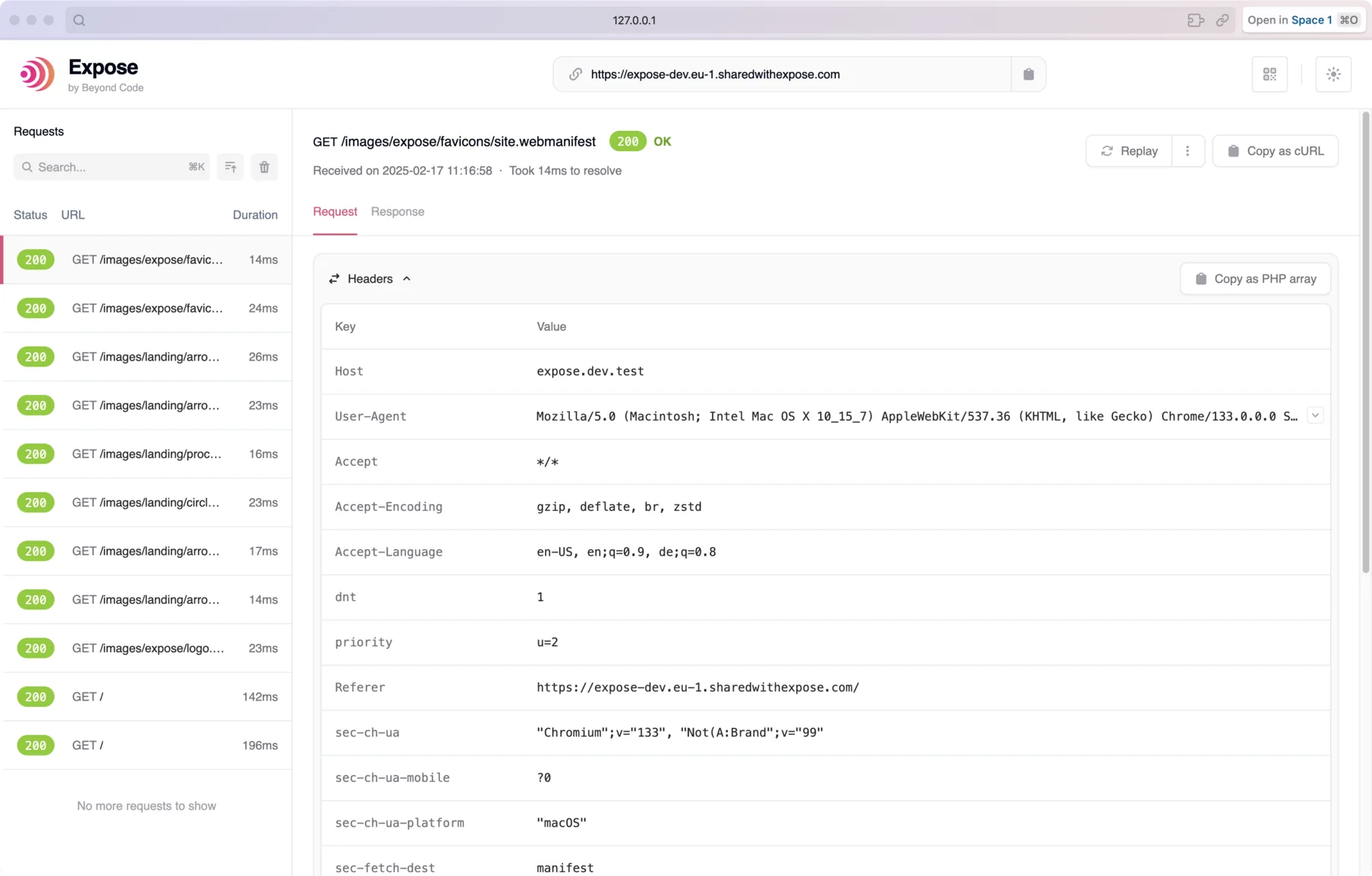
Expose doesn't bill for requests or data transfer on any plan. The free plan works well for webhook testing too. The catch is the random URL: you paste a new one into Stripe or GitHub each time you reconnect. The webhook testing guide walks through it.
What Expose Pro adds#
Expose Pro is $79 per user per year, before VAT. The yearly price is the price.
- No time limit on connections.
- A reserved subdomain that keeps the same URL on any Expose server:
expose share http://localhost:3000 --subdomain=my-app. See reserved subdomains. - Your own domain, such as
app.share.example.com, set up with one CNAME record. See custom domains. - Global servers in Frankfurt, New York, San Francisco, Singapore, São Paulo and Sydney. Pick one with
--server=us-2. See the server list.
For comparison, ngrok's cheapest paid plan on November 15, 2026 was Hobbyist: $10 a month, or $96 a year billed annually. It includes 100,000 requests, 5 GB of data transfer and up to 10 ngrok-branded domains. Hobbyist stops at its credit like the Free plan. Your own domain needs Pay-as-you-go, from $20 a month plus $0.01 per active hour.
If you share sites with clients or test webhooks every day, Pro removes the three things that get in the way on a free plan: the time limit, the changing URL and the single server. If ngrok's free plan covers what you do, keep using it. Read Expose vs ngrok for the full side-by-side, or see Expose pricing.